Syrian Delegation Discusses Academic Cooperation in Berlin
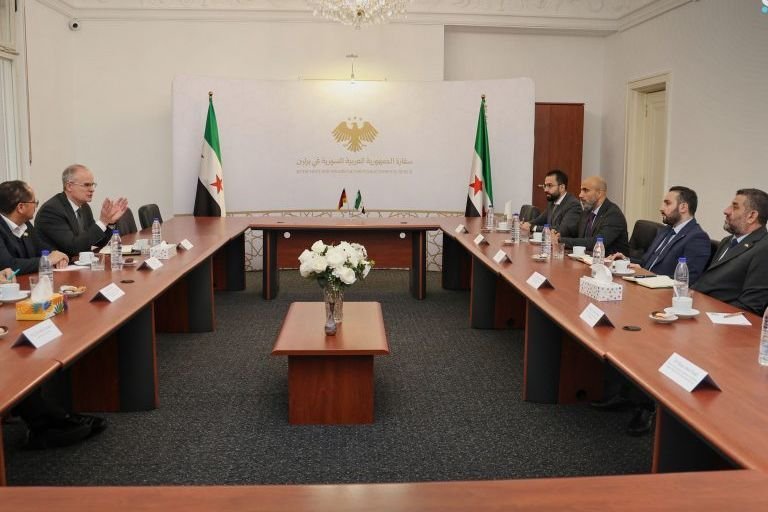
A delegation from the Syrian Ministry of Higher Education and Scientific Research concluded a two-day official visit to Berlin, where they explored avenues for strengthening academic and research cooperation with Germany. The mission aimed to foster scientific partnerships and provide critical support to the higher education sector in Syria.
The Syrian delegation included Dr. Abdul Hamid Al-Khalid, Assistant Minister of Higher Education and Scientific Research for Student Affairs; Dr. Nabil Qushji, Director General of the Higher Commission for Scientific Research; and Dr. Hanan Abu Hatab, Director of the Ministry’s International Cooperation Office. They were joined by Mohammad Baraa Shukri, Charge d’Affaires of the Syrian Embassy in Berlin.
The visit’s agenda featured a series of intensive meetings with officials from the German Federal Ministry for Economic Cooperation and Development (BMZ) and members of the Bundestag. The delegation also held discussions with representatives of the German Academic Exchange Service (DAAD) and met with Peter Greisler, Head of the Higher Education Department at the Federal Ministry of Education and Research.
Discussions centered on the current challenges facing Syrian universities and the priorities for advancing the higher education system. Key topics included the potential for expanding academic exchange programs, increasing scholarship support for students, updating scientific curricula, and training teaching staff. The parties also explored practical methods for equipping scientific laboratories and facilitating joint research projects.
As part of the initiative to promote scientific dialogue, the delegation participated in an event titled “Higher Education in the Syrian Transition Path.” Hosted by Humboldt University in Berlin, the session was organized by the “A New Beginning for Syria” platform in collaboration with Syrian academics and researchers based in Germany. The discussion highlighted the role of Syrian scientific expertise abroad in transferring knowledge and building academic capacity within Syria, as well as the contribution of this expertise to curriculum development.
Dr. Abdul Hamid Al-Khalid emphasized that the visit aligns with the Ministry’s efforts to open up to international experience. He noted that the discussions focused on transforming initial understandings into concrete opportunities, particularly in academic exchange, research infrastructure, and faculty training. He further stressed the importance of utilizing the expertise of Syrian professionals abroad for teaching and joint academic supervision.
Dr. Samer Karam, founder of the Syrian Scientific Council and a lecturer at the Technical University of Darmstadt, noted that the visit established a foundation for sustainable academic dialogue that addresses the practical needs of Syrian universities. He affirmed the Syrian Scientific Council’s readiness to connect Syrian academic institutions with international counterparts.
Professor Ralf Roesskopf, Vice President of the German Jordanian University and Director of the DAAD’s Syria project, underscored the importance of constructive dialogue in supporting the reform of Syrian institutions and strengthening their academic ties to the international community. Such efforts aim to build long-term partnerships that benefit students and researchers in Syria.
Source: Syria Focus Arabic
