
Syria and Saudi Arabia Partner on Massive Agricultural Feed Project
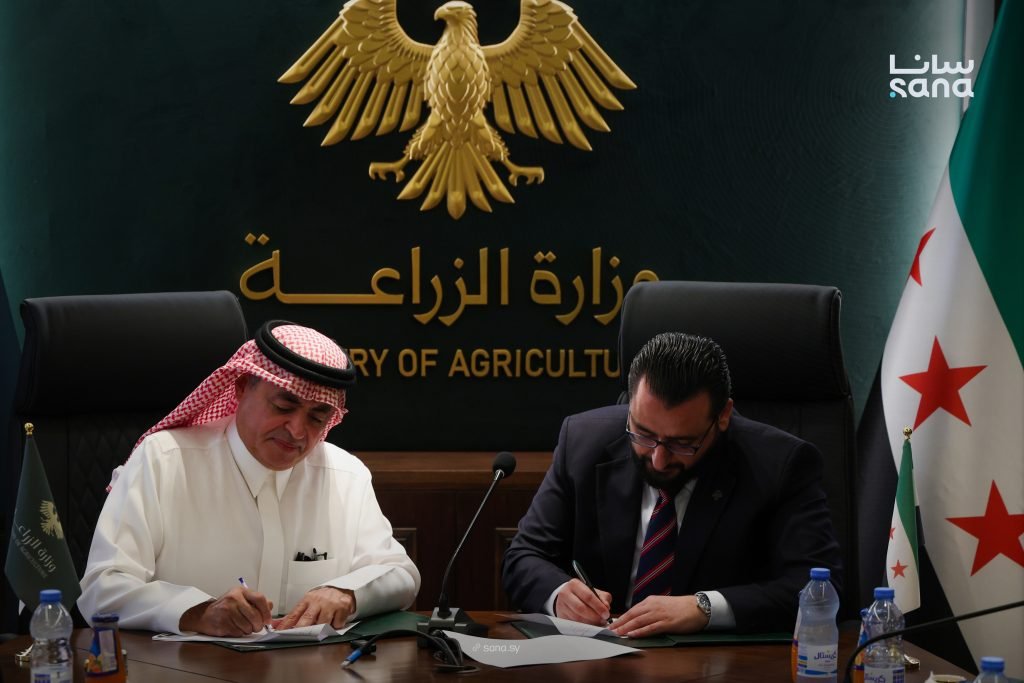
Syrian Minister of Agriculture Bassel Al-Swaidan and Emad Abdul Qader Al-Muhaidib, Chairman of the Saudi United Feed Company, have signed a memorandum of understanding (MoU) in Damascus to explore the development of significant agricultural and industrial infrastructure. The agreement marks a formal step toward establishing extensive fodder farms and specialized feed production facilities within Syria.
The proposed project targets the country’s eastern region, with officials identifying a potential area covering approximately 30,000 hectares. The plan envisions a vertically integrated model that combines large-scale crop production with advanced manufacturing capabilities. According to the framework outlined in the agreement, the farms are expected to utilize sustainable modern irrigation technologies, including circular and linear pivot systems, to ensure the efficient use of water resources in large-scale cultivation.
Beyond the agricultural aspect, the memorandum includes provisions for integrating these farms with dedicated feed processing plants. The scope of the project also covers the development of logistical support infrastructure necessary to facilitate the production, processing, and distribution of animal feed. This approach aims to create a robust supply chain capable of supporting domestic needs and broader agricultural development.
The signing ceremony, held at the Ministry of Agriculture headquarters in Damascus, highlights an emerging effort to revitalize sections of Syria’s agricultural sector. By focusing on the eastern region, the partnership aims to leverage the vast arable land available there to address shortages in fodder production, which remains a critical challenge for livestock sectors across the region.
While the current agreement is limited to a feasibility study and the initial planning stages, it represents a notable development in bilateral economic cooperation. The integration of Saudi private sector technical expertise and investment interest with Syrian land resources signals a strategic attempt to modernize agricultural practices through high-capacity irrigation and industrial manufacturing.
Industry observers note that if the study results in the full implementation of the 30,000-hectare project, it would constitute one of the most significant agricultural investments in the region in recent years. The emphasis on sustainable irrigation and integrated logistics suggests a long-term strategy to increase production efficiency and reduce reliance on imported feed materials. As the project moves into the study phase, both parties are expected to assess the technical requirements and regulatory framework necessary to move forward with construction and operational deployment in the coming period.
