Damascus Hosts Scientific Event for Perseid Meteor Shower Observation
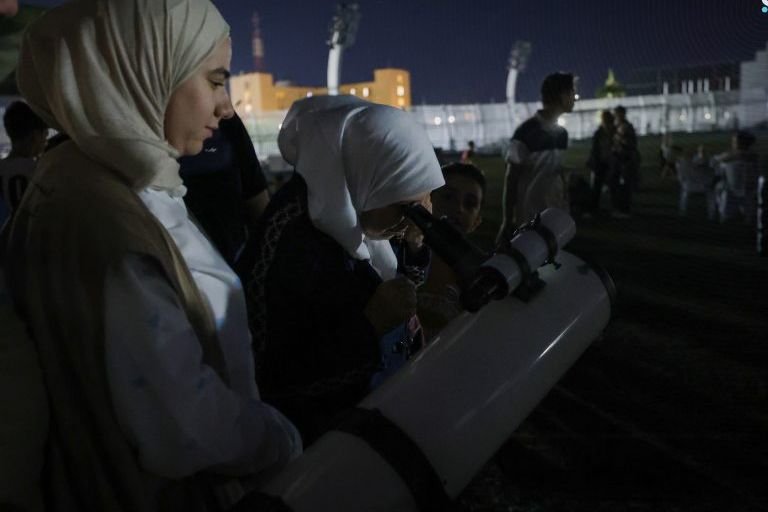
The Syrian Astronomical Society, in coordination with the Directorate of Sports and Cultural Activities of Damascus Governorate, hosted a public scientific event on Thursday evening to observe the Perseid meteor shower. The gathering, held at the Mohafazat Club in the Kafr Sousa district of Damascus, attracted a diverse crowd of families, children, and astronomy enthusiasts eager to engage with space science through direct observation.
Participants were provided with the opportunity to observe the celestial phenomenon and learn about the origins and physical processes behind the meteor shower. The timing of the event, which coincided with the peak of the Perseids and a new moon phase, ensured a dark sky, significantly improving visibility for the observers, particularly for viewing dimmer meteors.
Mohammad Al-Asiri, head of the Syrian Astronomical Society, explained that the Perseids are caused by Earth passing through a stream of dust and debris left behind by the comet 109P/Swift-Tuttle. When these particles enter the Earth’s atmosphere at high speeds, they frictionally interact with air molecules, causing them to heat up and glow, which manifests as streaks of light from the perspective of observers on the ground. He noted that the Society is utilizing the event to perform a scientific count of the meteors, recording data that will contribute to ongoing studies regarding meteor activity.
Al-Asiri noted that in ideal conditions, the hourly rate for the Perseids can reach approximately 100 meteors per hour. However, the number actually visible to the public is subject to variables including sky clarity, light pollution levels in the urban environment, and the specific vantage point of the observer. He encouraged participants to continue observation during the late night and pre-dawn hours for the best results.
In addition to the meteor shower, the event featured the use of telescopes to view other astronomical bodies. Al-Asiri emphasized that such initiatives are vital for bridging the gap between theoretical space science and the general public, fostering an environment where attendees can witness celestial mechanics firsthand.
Turkiya Jabbour, a member of the Syrian Astronomical Society, highlighted the educational impact of the event, stating that the primary goal is to train participants—especially children and youth—in observational techniques and the scientific interpretation of natural phenomena. By providing access to specialized equipment and experts, the Society aims to encourage early interest in the sciences and correct common misconceptions surrounding astronomical events.
Local participants, such as Hamza Al-Hamzawi, expressed appreciation for the event, noting that the observation of such cosmic phenomena encourages contemplation of the precision of the universe. Khaled Qataa, representing the Directorate of Sports and Cultural Activities, confirmed that the high turnout demonstrated the community’s strong interest in scientific and cultural programming, with operations continuing until the early hours of Friday morning to maximize the viewing experience for all attendees.
