Damascus Library Hosts Lecture on the Global Impact of Arabic
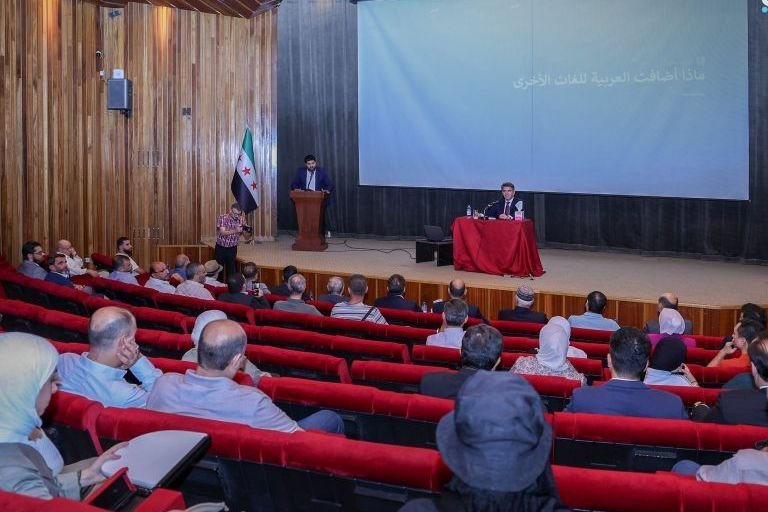
The Syrian National Library in Damascus recently hosted a cultural lecture titled “What Has Arabic Added to Other Languages?” presented by researcher and journalist Mahmoud Al-Zeibaq. The session examined the significant role of the Arabic language in shaping the intellectual, cultural, and social frameworks of various societies throughout history.
During the lecture, Al-Zeibaq highlighted the inherent flexibility of Arabic and its capacity for cross-cultural engagement. He emphasized that language functions as more than a simple communication tool; it acts as a reflection of thought processes and mental imagery. This discussion was contextualized within the linguistic field of “linguistic relativity,” which explores how the structure of a language influences a speaker’s perception of the world.
Al-Zeibaq provided examples of long-standing cultural exchanges fostered through trade and translation. He noted that the Arabic word “suffa” migrated into various European languages, eventually evolving into the English word “sofa.” However, he cautioned that scientific research into the etymology of vocabulary requires precise historical tracking, warning against unsubstantiated theories that incorrectly claim Arabic is the root of all world languages.
Tracing the history of academic interest in Arabic, the lecturer pointed to European institutions such as Leiden University in the Netherlands, which became an early hub for Arabic studies beginning in 1613. He explained that modern technological advancements, particularly in digital archiving, have enabled contemporary researchers to track the sources of manuscripts with greater accuracy, allowing for a more objective re-evaluation of how knowledge traveled between the East and Europe.
In his review of the contributions made by Arab and Muslim scholars to human knowledge, Al-Zeibaq highlighted the work of Al-Khalil ibn Ahmad al-Farahidi in the field of prosody, as well as the achievements of Al-Khwarizmi in algebra and arithmetic. He noted that the 12th-century Latin translations of Al-Khwarizmi’s work served as the gateway for introducing the decimal positional number system and the concept of zero to Europe—works that later became associated with the term “algorithm.”
Mahmoud Al-Zeibaq concluded the lecture with an invitation to revisit the Syrian and Arab cultural heritage through a balanced scientific lens. He characterized the history of human culture as a continuous chain of creative human exchange and interaction. Al-Zeibaq is a researcher specializing in cultural and historical affairs, known for his extensive work in documenting and analyzing the movement of knowledge between East and West, alongside a long career in media.
