Mustafa Najjar: A Half-Century Dedicated to Arabic Calligraphy
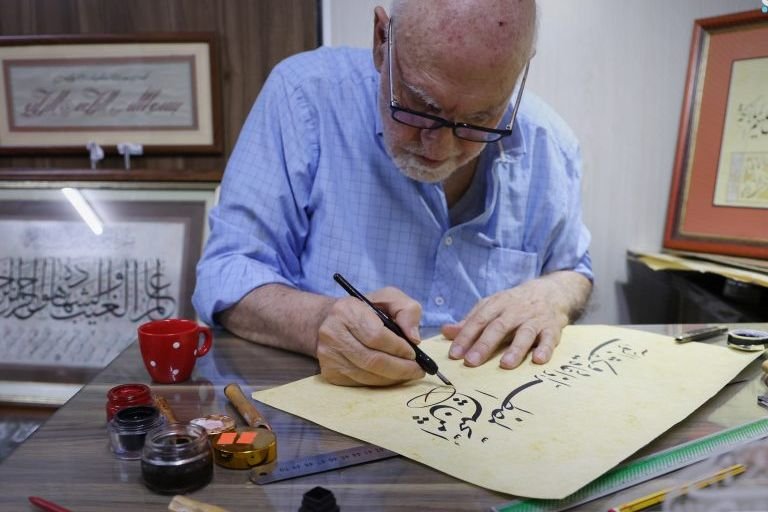
For more than half a century, Syrian calligrapher Mustafa Najjar has dedicated his life to the pursuit of beauty through the Arabic script. His journey, which spans across Hama, Damascus, and the Saudi city of Medina, represents a life defined by rigorous practice, constant learning, and a deep-seated commitment to preserving and evolving this ancient art form.
Najjar’s fascination with calligraphy began in his youth in Hama. Observing students crafting their own writing implements from reeds and wood, he was inspired to fashion his first tools from simple wooden laundry pegs. This early ingenuity marked the start of a lifelong relationship with the craft, transforming a childhood curiosity into a career marked by professional mastery.
His formal development was shaped by several influential figures. The late Abdul Rahman al-Fakhoury was the first to leave a lasting impact on his work. Through careful observation and dedicated study under al-Fakhoury’s guidance, Najjar transitioned from a passionate hobbyist to a skilled calligrapher. Upon moving to Damascus, he sought to challenge himself further, drawing inspiration from the artist Jamal Boustan and setting a personal goal to reach and eventually surpass his mentor’s level of proficiency. Between 1972 and 1979, he studied under the late Mahmoud al-Hawari, who provided crucial insights into the commercial aspects of the craft, including the production of signage and copper engraving.
Najjar is highly regarded for his mastery of various scripts, yet he holds a particular affinity for the Ta’liq style. Influenced by the late master Badawi al-Dirani, Najjar asserts that Ta’liq is an authentic Arabic script. He has developed his own unique interpretation of the style, which he describes as ‘Damascene Ta’liq.’ His artistic contributions have been showcased at various exhibitions and forums in Syria, as well as internationally in countries including China, Germany, Ireland, and Saudi Arabia.
A significant milestone in his career occurred in 2015 when he was awarded first place for his Nastaliq script at a competition hosted by the Islamic University of Medina. For Najjar, this recognition was deeply personal, representing a validation of his place among the world’s leading calligraphers.
One of his most ambitious undertakings was a project to transcribe the Holy Quran in the Naskh script. Beginning in 2009, he completed approximately 570 pages of the manuscript. However, the onset of the conflict in Syria forced him to relocate, leaving the project incomplete as he was unable to finalize the necessary proofreading and printing stages.
Beyond his artistic pursuits, Najjar spent five years as a competitive bodybuilder. He believes that his athletic background provided him with the physical discipline, patience, and focus necessary to excel in the demanding field of calligraphy. He remains a staunch advocate for traditional techniques, cautioning that while digital tools have their place, they cannot replace the foundational training and human soul that define a true calligrapher’s work. Reflecting on his long career, he emphasizes that mastery requires only two things: passion and patience.
