
Latakia Port Boosts Container Handling with Six New Cranes
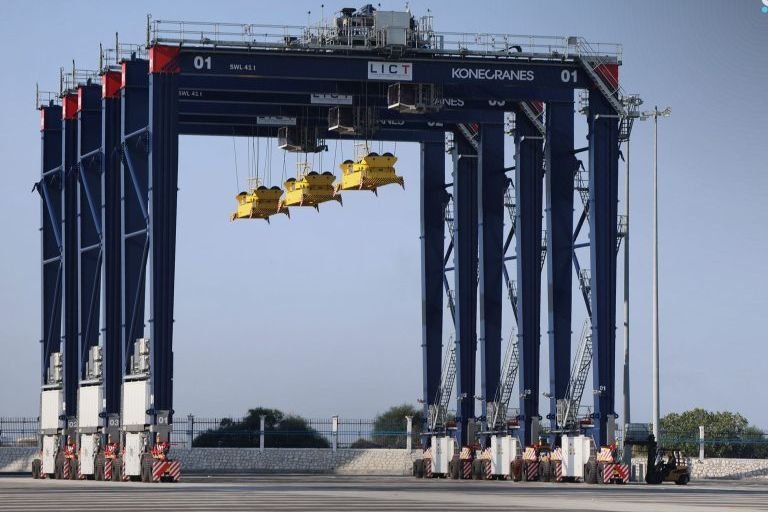
Latakia Port received six modern fifth-generation bridge cranes on Thursday, intended for the Latakia International Container Terminal (LICT). This delivery is part of a joint project with the CMA CGM Group, aimed at upgrading terminal equipment, boosting operational capacity, accelerating container handling processes, and improving service standards for arriving vessels.
Abdul Hamid Al-Wahab, Director of Latakia Port, confirmed that the integration of the new cranes represents a significant qualitative improvement for the port’s general cargo and container sectors. He noted that the equipment will reduce vessel turnaround time while increasing handling efficiency and service speed. Al-Wahab explained that the General Organization for Ports and Customs strategy focuses on leveraging Syria’s strategic location by modernizing machinery, developing infrastructure, and adopting digital transformation systems. These efforts are expected to positively impact performance indicators, he added, noting that the port has handled approximately 4 million tons of cargo over the past few months of this year.
Faisal Huwaylo, Director of the Latakia International Container Terminal, stated that the new hybrid-type (E-RTG) cranes constitute the highlight of the first phase of the terminal development project. The project is being executed in coordination with the General Organization for Ports and Customs and aligns with the CMA CGM Group’s environmental responsibility commitments. Huwaylo pointed out that these cranes enable vertical container stacking, which allows for better utilization of space within the terminal and facilitates more efficient cargo movement. He added that the system enhances safety and operational consistency, serving as a replacement for the previously used straddle carrier system.
Furthermore, Huwaylo revealed that the first phase of the development project is scheduled for completion within the next two months. This will coincide with the initiation of the second phase, which involves maritime geotechnical studies to assess soil composition and sea depths. The objective of these studies is to determine the appropriate draft for future stages and meet the requirements of prospective expansion. He emphasized that these updates are part of a broader strategy to increase terminal productivity, reduce congestion, and accommodate a larger number of ships, while also supporting goals to lower carbon emissions and reach net-zero by 2050.
Notably, the modernization of port operations is ongoing; late last September, Latakia Port received a shipment of 16 modern forklifts, each with a lifting capacity of three tons, as part of continuous efforts to upgrade machinery.
Source: Syria Focus Arabic
