Ibn Malik’s Alfiyya: A Legacy of Arabic Grammar in Damascus
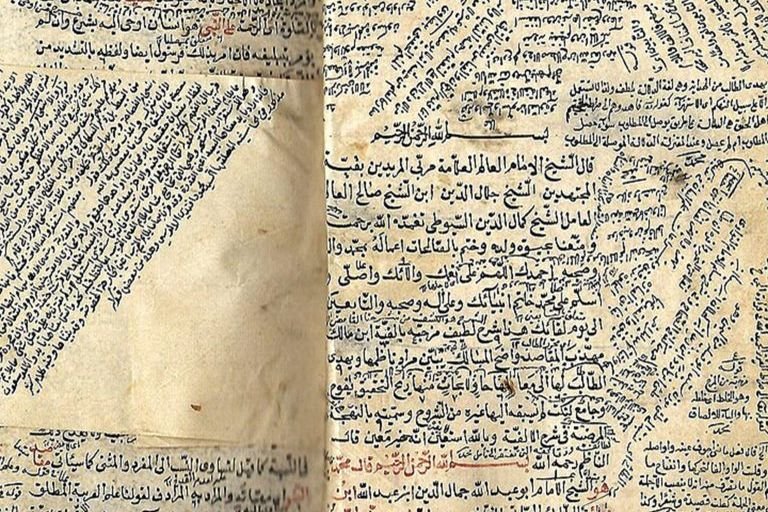
The Alfiyya, a masterwork of Arabic grammar, continues to hold a position of paramount importance in the history of the Arabic language. Written by Jamal al-Din Muhammad ibn Abd Allah ibn Malik, the text serves as a comprehensive and highly structured summary of grammatical and morphological rules. Since its creation, it has been a cornerstone of linguistic education, prized for its conciseness and pedagogical utility.
Ibn Malik, a prominent scholar of the seventh century Hijri, was born in Jaen, Andalusia, in 1203 AD. He later migrated to the Levant and established himself in Damascus, where he eventually passed away in 1274 AD. During his time in the Syrian capital, he cemented his legacy as one of the preeminent figures of Arabic studies. Beyond the Alfiyya, his scholarly contributions include ‘Al-Kafiya al-Shafiya,’ ‘Tashil al-Fawa’id,’ and ‘Lamiyyat al-Af’al.’
What differentiates the Alfiyya from other works is its unique role as both a curriculum for students and a foundation for advanced academic analysis. The text was designed as an abridged version of his earlier, more expansive work, ‘Al-Kafiya al-Shafiya.’ By distilling the complexities of Arabic grammar into a series of refined verses, Ibn Malik created a resource that is accessible to learners while providing sufficient depth for seasoned scholars to expand upon. This structure facilitated the rise of a vast tradition of commentary, footnotes, and critical studies that evolved over centuries.
Modern scholarship continues to underscore the text’s enduring influence. A study published in the ‘Journal of Comprehensive Sciences’ in 2026 identifies the Alfiyya as one of the most significant educational systems in Arabic grammar, noting its profound impact on both historical and contemporary linguistic pedagogy. The text acts as a gateway for understanding the diverse methodologies scholars have used to interpret grammatical rules and resolve linguistic disputes.
Several seminal commentaries have shaped the reception of the Alfiyya. Ibn Aqil’s commentary is widely recognized for its educational approach, characterized by clarity, brevity, and a focus on essential grammatical tenets. By contrast, the commentary by Al-Ushmuni is often described as encyclopedic, providing extensive citations, logical justifications, and a detailed survey of various schools of thought. Other major works, such as the ‘Al-Maqasid al-Shafiya’ by Abu Ishaq al-Shatibi, offer deep analytical insights into the complexities of the text, further validating its status as a living, evolving project.
Today, the Alfiyya is more than a historical relic; it is a primary tool for studying the evolution of Arabic grammar and the methods of scientific inquiry within the Arab world. The longevity of the work confirms that Ibn Malik did not merely write a book; he established a scholarly tradition that continues to thrive in academic circles, reflecting a legacy of intellectual production deeply rooted in the history of Damascus and the wider region.
