
New Marketing Market Opens in Jdeidet Artouz for Regenerative Agriculture
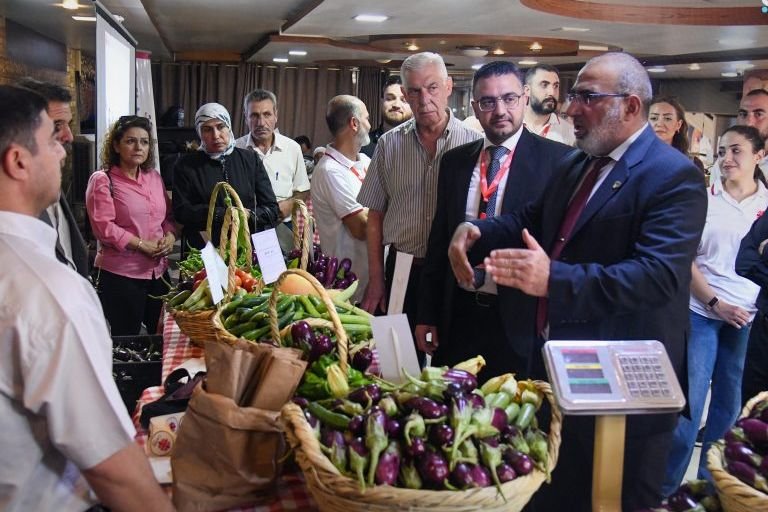
Caritas Syria, in collaboration with the Directorate of Agriculture in Damascus and Rif Dimashq, has inaugurated a new marketing market in the town of Jdeidet Artouz. The facility serves as a dedicated space to showcase and sell produce harvested by families participating in the local home garden project based in the Qatana area, marking the initiative’s transition into its full production phase.
The two-day market highlights the progress of the project, which aims to promote sustainable farming practices within the region. Displayed items include a variety of regenerative agricultural supplies, such as drip irrigation systems, vermicompost, compost worms, plant extracts, and organic fertilizers and pesticides. In addition to agricultural tools, the market offers fresh and dried vegetables, medicinal and aromatic plants, and traditional food supplies known as ‘mouneh’.
Innovation is a central theme of the exhibition, which features models of soil-free cultivation, including vertical and hydroponic farming systems. Attendees can also observe functional models of sustainable agricultural infrastructure, such as insect hotels, composting units, mobile chicken coops, and solar-powered fruit drying units.
Zaid Abu Assaf, Director of Agriculture in Damascus and Rif Dimashq, stated that the project has successfully supported 80 beneficiaries. Throughout the duration of the season, these participants were provided with essential agricultural inputs, including water tanks, irrigation networks, seeds for both winter and summer crops, and fertilizers. Beyond the provision of supplies, the directorate maintained regular oversight to provide technical guidance on installation and production techniques.
According to Abu Assaf, the primary objective of this initiative is to establish experimental conservation farming practices. By introducing farmers to methods for soil rehabilitation and land utilization, the project seeks to produce organic crops free from chemical residues and contaminants.
Michele Ndour, manager of the agricultural livelihoods project at Caritas, emphasized that the market represents the culmination of the project’s activities. He noted that the initiative focuses on regenerative and climate-smart agriculture to bolster farmers’ resilience against climate change and water scarcity, all while maintaining low production costs. In addition to the market exhibition, the project has conducted a series of technical training sessions and provided grants aimed at enhancing the capabilities and productivity of local farmers.
Participating families reported that the new market provides a vital platform for them to reach customers directly, helping to secure a better income and improve their living standards. Furthermore, the participants highlighted that adopting regenerative farming methods has been instrumental in reducing costs and adopting sustainable practices without compromising product quality. These agricultural methods prioritize the improvement of soil fertility, the promotion of biodiversity, carbon sequestration, and the support of the water cycle, all of which are critical in mitigating the long-term effects of climate change in the Syrian countryside.
