
Syria Signs Agreement for ‘Ebla’ Submarine Cable to Boost Connectivity
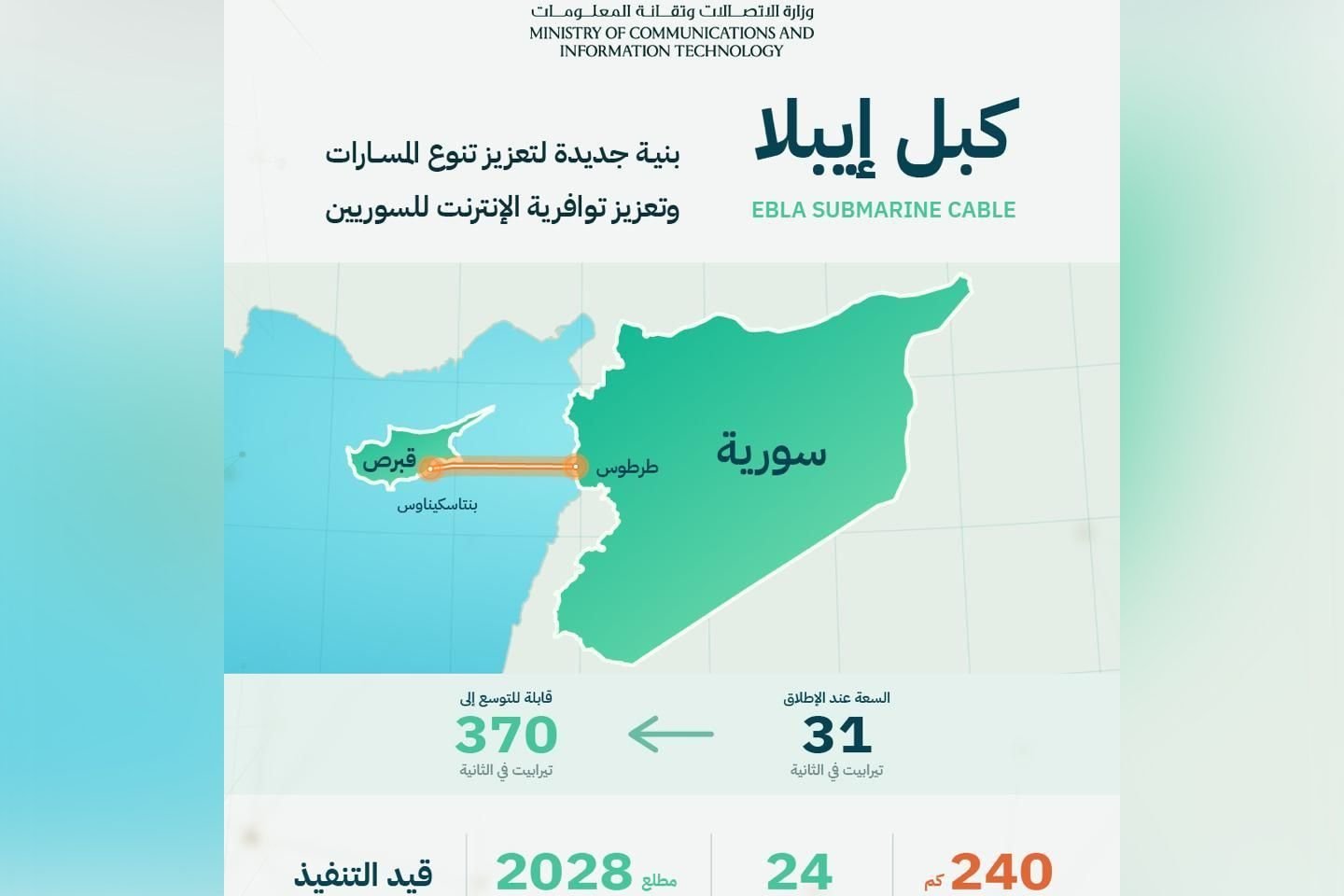
The Syrian Ministry of Communications and Technology has officially signed an agreement for the construction of the “Ebla” submarine cable. This strategic initiative is designed to modernize Syria’s international telecommunications network and diversify its digital pathways. The project is the result of a collaborative partnership between the Syrian Telecom, the Cyprus Telecommunications Authority (Cyta), and the American firm Unifi Communications, aligning with the Ministry’s overarching strategy to upgrade the country’s internet and telecommunications infrastructure.
According to an official statement from the Ministry, the new cable will establish a direct link between the city of Tartus and the Pentaskinos landing station in Cyprus. Featuring advanced technology, the cable includes 24 pairs of optical fibers. Upon commencement of operations, it will offer an initial data transmission capacity of 31 terabits per second, with the potential for future expansion up to 370 terabits per second. This connection is expected to provide reliable, direct access to European and global networks via the infrastructure of the Cyprus Telecommunications Authority.
This initiative is part of an integrated vision to develop the national internet ecosystem. The Ebla project is being implemented alongside plans for a Syrian landing station on the Medusa submarine cable, as well as the “Silk Link” project, which aims to develop an essential, open-access national fiber-optic network. Collectively, these projects seek to connect submarine landing stations to major cities, data centers, and land borders, bolstering Syria’s capacity to serve as a key transit point for data traffic between Europe, neighboring countries, the Gulf, and Asia.
Regarding service improvements, the Ministry emphasized that these investments will enhance the quality and reliability of communications. By diversifying data paths, the project reduces the risk of service interruptions and provides increased bandwidth to support growing digital demands, including e-government services, remote education, and cloud computing. Furthermore, the project aims to foster a competitive environment that offers subscribers broader options at more affordable prices, while supporting local data hosting and providing the infrastructure necessary for future economic investments.
Technical preparations are currently underway. The Ministry has ordered marine equipment from the NSW facility, a subsidiary of Prysmian, while Elettra has been commissioned for the cable-laying operations, and Nokia has been contracted to supply optical transmission equipment. Marine surveys for the route are ongoing, with the cable scheduled to enter service in early 2028, pending the completion of required licenses and favorable maritime conditions.
Minister of Communications and Technology, Abdulsalam Haykal, stated that relying on a single international route is no longer a sustainable option. He noted that the Ebla project will restore a direct link to the world via Cyprus. The Ministry is currently negotiating additional cables to solidify the status of Tartus and Latakia as regional landing hubs, transforming Syria’s geographical location into a digital advantage.
Representatives from the Cypriot side highlighted the project’s importance in strengthening regional cooperation and developing the digital architecture of the Eastern Mediterranean. The American partner expressed pride in contributing to this ambitious vision, which aims to enhance Syrian connectivity on both regional and global levels. The Ebla project is set to replace the Ugarit cable, which entered service in 1995, marking a significant step forward in meeting Syria’s increasing demand for telecommunications services.
