Syria Holds Training Workshops to Revive Traditional Calligraphy Arts
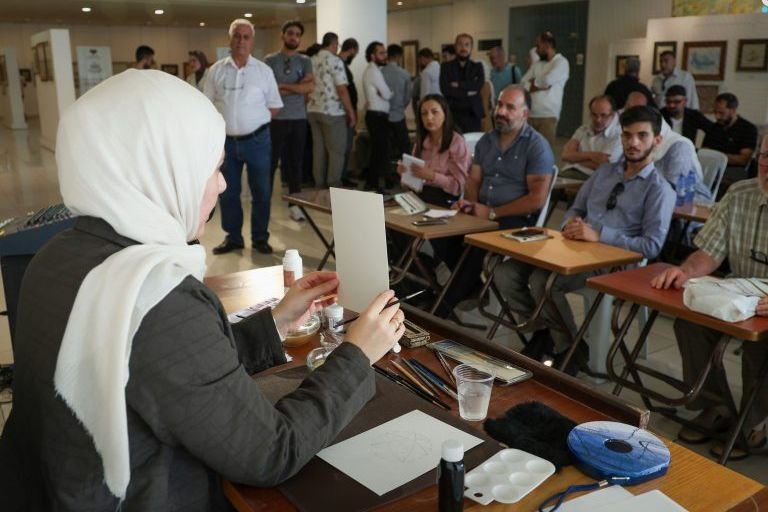
The National Center for Visual Arts in Damascus recently hosted the third day of the Syrian Symposium for Arabic Calligraphy and Decoration, a specialized event dedicated to reviving and honing the skills of young artists. The program provided a comprehensive platform for calligraphers, trainers, and students from various Syrian governorates to engage in intensive, hands-on training sessions aimed at preserving the aesthetic traditions of Arabic script.
The workshop series covered several fundamental pillars of Islamic artistic practice, including Riq’a and Diwani calligraphy, as well as the intricate craft of gilding. These sessions were designed as interactive experiences, allowing established masters to transmit technical knowledge and artistic nuances to the next generation of practitioners.
Sarah Othman, a specialist in gilding, led an interactive workshop that explored the deep historical roots of this art form. She detailed the evolution of gilding from its early Islamic origins, through the Umayyad, Abbasid, Mamluk, and Ottoman eras, when it was primarily used to illuminate manuscripts and Holy Qurans. Participants were introduced to the demanding techniques required for professional work, including the preparation of natural pigments, the use of ground precious stones, and the application of gum water for bonding gold leaf. Othman also emphasized the precision required for burnishing, a process essential to achieving the characteristic luster of a finished piece.
In the realm of script evolution, calligrapher Anas Fattouhi conducted a session on the Diwani style. He described the script as one of the most flexible and fluid forms of Arabic writing, noting its origins in the Ottoman administrative courts where it served as the official medium for royal decrees and sensitive correspondence. Fattouhi highlighted the distinction between the standard, more readable ‘Khafi’ Diwani and the more decorative ‘Jali’ Diwani, which is known for its intricate interweaving of letters and the dense, ornate filling of negative spaces to create a cohesive visual composition.
Complementing these styles, calligrapher Morhaf Abdul Hamid focused on the practical application of the Riq’a script. Recognized for its simplicity, speed, and clarity, Riq’a remains one of the most widely used scripts for daily administrative and personal communication. Abdul Hamid taught participants how to master its characteristic sharp angles and the relative absence of vowel markings, which distinguishes it from more ornamental, circular scripts such as Thuluth.
During the event, Minister of Culture Mohamed Yassin al-Saleh toured the symposium’s various sections. He observed the participants in action and engaged with trainers regarding the importance of these workshops in maintaining the presence of traditional arts in the contemporary Syrian cultural landscape. The symposium concluded with a strong emphasis on the role of such educational initiatives in fostering talent and ensuring that traditional artistic disciplines remain a living, evolving part of Syria’s creative identity.
