
Old Damascus Trades: From Market Bustle to Family Legacies
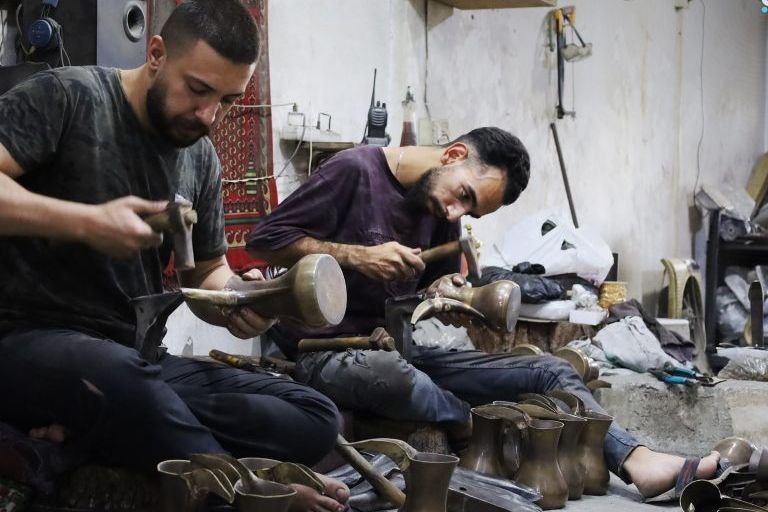
Traditional trades and handicrafts once defined the vibrant life of the neighborhoods and markets of Damascus. Far from being mere sources of income, these professions were an inseparable part of the city’s cultural and social fabric, leaving a lasting impression on popular memory through their specialized tools, the distinct calls of craftsmen, and the legacy of family surnames passed down through generations.
A study titled “Extinct Handicrafts,” authored by researcher Ahmed Boubes and published by the Syrian Ministry of Culture’s Folklore Magazine, explores this heritage. The study examines various trades that once fulfilled the daily needs of the city’s residents. As modern lifestyles and production methods have accelerated, many of these professions have declined or vanished entirely. However, their memory persists in the names of Damascene families, who bear the titles of their ancestors’ professions as a permanent link to the past.
The research highlights crafts deeply integrated into every aspect of life in old Damascus. Among these were the ‘Saqqa’ (water carrier), responsible for delivering water to homes; the ‘Makkari,’ who relied on animals for transportation; and the ‘Mubayyad,’ who maintained copper utensils. Other specialized artisans included the ‘Saruji,’ who crafted horse saddles, and the ‘Qabbaqibi,’ who made traditional wooden clogs.
The markets were also frequented by craftsmen such as the ‘Majallakh,’ who sharpened knives; the ‘Naddaf,’ who specialized in processing cotton; the ‘Maqashati,’ who made brooms; and the ‘Sha’al,’ who was tasked with lighting and maintaining street lanterns.
The culinary heritage was equally prominent in this landscape. The ‘Humsani’ and ‘Fawwal’ became famous for serving popular local meals, while the persistent call of the ‘Arqsousi’—a wandering vendor selling licorice drink—remains etched in the minds of the people of Damascus. According to historian Mahmoud Dabbour, these professions served as a mirror for the city’s economic and social life, with markets and workshops acting as vital hubs for the transmission of skills and expertise between generations.
Dabbour explains that the transition of these trade names into inherited family surnames—such as Al-Haddad (the blacksmith), Al-Najjar (the carpenter), Al-Attar (the spice merchant), and Al-Qassab (the butcher)—reflects the historical importance of professional practice in defining social identity. While many descendants have moved away from their ancestors’ original crafts, these surnames remain testament to the city’s history and professional roots. Dabbour emphasizes the need for ongoing documentation of this heritage, urging the collection of family accounts, documents, and oral testimonies from the elderly before these historical details are lost with the passing of those who experienced them.
Documenting these crafts is not merely about preserving the names of professions. It is about safeguarding both the material heritage represented by specialized tools and the intangible heritage consisting of terminology, narratives, and social customs that helped shape the cultural identity of Damascus. These trades represent open pages in the city’s history, reflecting the skills and lifestyles of previous generations.
Source: Syria Focus Arabic
