Al-Hijri Says Druze Are Part of Israel… Israel Caught Off Guard
Amman – Adnan Masalma | Syria Focus
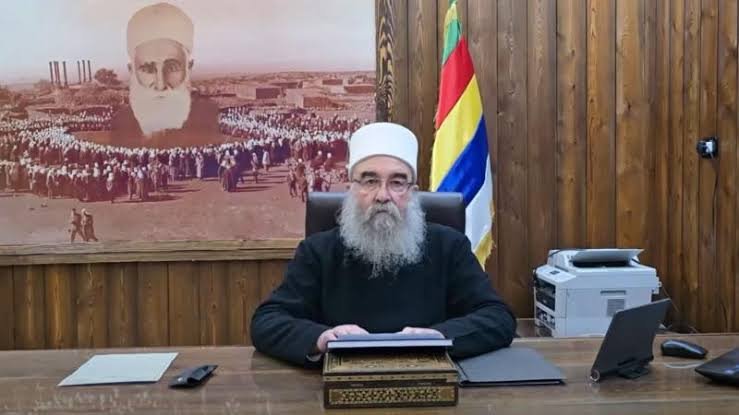
At a highly sensitive moment in Syria’s rapidly shifting political landscape, Sheikh Hikmat al-Hijri, one of the senior Druze spiritual leaders in Sweida, declared that the Druze are “an integral part of the State of Israel” — a striking departure from his previous political rhetoric.
The statement came amid major changes in the balance of power across Syria. But according to exclusive information obtained by Syria Focus correspondent Adnan Masalma in Amman from multiple sources, the statement was not coordinated in advance with Israel. Israeli officials and media figures were reportedly caught off guard by al-Hijri’s remarks, even as Israel had, in recent weeks, been urging him to de-escalate through Israeli Druze leaders.
The information gives al-Hijri’s statement a different political significance. Rather than simply adopting a tougher position toward Damascus, he dramatically raised the level of his rhetoric toward Israel at a time when, according to Syria Focus sources, Israel was seeking to contain tensions.
The timing coincided with a major development involving the Syrian Democratic Forces (SDF). Mazloum Abdi announced the end of the SDF as an independent military force and the beginning of its integration into Syrian state institutions.
The move marks the end of a period in which the SDF maintained an independent military, security and administrative structure outside Damascus. According to information and reporting followed by Syria Focus, the previous phase also saw overlapping interests among forces linked to al-Hijri, the SDF, and figures and groups associated with remnants of the former Assad regime, including Ghazal Ghazal.
This was not an officially declared alliance, but it created a political and security environment that gave the various sides greater room for maneuver.
With the SDF now entering the state integration process, that environment has changed, leaving al-Hijri with a narrower political space in which to operate.
At that point, al-Hijri faced a choice: lower the level of confrontation or look for a new source of leverage to reassert Sweida’s position in Syria’s changing political landscape. He chose the latter.
From an Independent Druze Entity to Israel
For months, al-Hijri’s rhetoric had focused on Sweida’s distinct identity and its right to self-determination, eventually developing into calls for an independent Druze entity backed by Israel.
His latest remarks, however, went significantly further.
“We even share a common faith with this state, the State of Israel,” al-Hijri said. “We, as Druze Unitarians, are an integral part of the State of Israel.”
He also referred to expected developments in the coming days, claiming that the Sweida issue was being overseen by Western countries and the United States through Israel. He said that securing Sweida’s right to self-determination and its full sovereign rights could form the basis for wider regional stability.
The distinction between the two positions is significant.
Calling for an independent Druze entity represents a political project of its own. Declaring that the Druze are part of Israel, however, moves the issue into a fundamentally different territory — one involving identity, sovereignty and political affiliation.
It can therefore be read as an attempt to send Damascus a message that the collapse of the SDF as an independent force does not mean the disappearance of Sweida’s political leverage.
But experts and observers believe that choosing this particular card carries substantial political risks and may have been an uncalculated reaction to the rapid changes taking place around him.
Al-Hijri did not simply invoke Israeli support. He moved the rhetoric toward the far more consequential question of affiliation.
Israel Caught Off Guard
According to the exclusive information obtained by Syria Focus correspondent Adnan Masalma from multiple sources, al-Hijri’s statement was not coordinated in advance with Israeli authorities.
The sources say Israeli officials and media figures were caught off guard by his remarks and that the statement was not part of any position previously agreed with Israel.
The sources further indicate that Israel had, in recent weeks, used Israeli Druze leaders to convey messages to al-Hijri urging him to de-escalate.
That detail is particularly significant given the nature of his latest remarks.
Al-Hijri did not merely refer to Israeli protection or political support. He used the language of direct affiliation with Israel at a time when Israeli contacts were, according to Syria Focus sources, focused on reducing tensions.
The statement therefore appears to have been al-Hijri’s own political initiative at a highly sensitive moment, rather than an Israeli declaration delivered through him.
Shock Inside the Druze Community
The reaction was not limited to Damascus and Israel. The statement also came as a surprise within the Druze community in Sweida.
Political positions in Sweida do not form a single unified bloc, and al-Hijri’s remarks cannot automatically be taken as representing all Syrian Druze.
The shift from a political discourse centered on independence and self-determination to one declaring affiliation with Israel represents a major change in the nature of the message.
It also leaves al-Hijri facing a question from within his own constituency: Is the goal still an independent Druze state, or does the new rhetoric signal a fundamentally different political direction?
Observers believe this may prove to be one of the most sensitive issues for al-Hijri, because any political project requires clear objectives and the ability to maintain the support of its own constituency.
A Message to Damascus
The timing of the statement cannot be separated from the broader transformation in Syria’s balance of power.
The SDF’s move toward integration into state institutions removes one of the most important independent centers of military and political power that existed outside Damascus.
For al-Hijri, that meant the disappearance of one element of the environment that had previously given him greater room for maneuver.
Against this backdrop, his latest statement can be understood as an attempt to reinforce Sweida’s position by signaling that the province still has an external relationship capable of exerting pressure on Damascus.
But the choice of Israel as that source of leverage carries a much higher political cost.
The statement does not merely concern security arrangements or external support. It touches directly on questions of identity and sovereignty, making its implications far broader than a conventional negotiating position.
An Escalation That Could Backfire
Experts and observers believe al-Hijri’s statement may have been an uncalculated reaction to the rapidly changing balance of power.
His apparent objective was to demonstrate that Sweida had not lost all of its leverage following the transformation of the SDF and the realignment of other forces.
But the move may have produced the opposite effect.
There has been no announced Israeli position endorsing al-Hijri’s formulation. On the contrary, the information obtained by Syria Focus indicates that Israeli officials were caught off guard, while Israel had been pushing for de-escalation through Israeli Druze channels.
At the same time, the statement has opened a debate within the Druze community over the difference between seeking an independent political entity and declaring affiliation with another state.
The message intended for Damascus has therefore become a much broader political issue, raising questions about the future of al-Hijri’s own political project.
From Leverage to Political Liability
Al-Hijri appears to have sought to send Damascus a clear message: Sweida has not lost its leverage despite the changing regional and Syrian landscape.
But declaring that the Druze are “an integral part of the State of Israel” has raised the political cost of that message considerably.
It places al-Hijri in a difficult position with Israel, which, according to Syria Focus sources, did not ask him to make such a statement and was caught off guard by it; with a Druze community that was surprised by the shift in his rhetoric; and with Damascus, which is now operating in a new political environment following the end of the SDF’s existence as an independent force.
The statement has also revived a fundamental question about the project al-Hijri has promoted: If the objective was an independent Druze entity in Sweida, what does declaring the Druze to be part of Israel mean for that project?
Ultimately, al-Hijri appears to have intended his statement as a demonstration that Sweida still possessed significant political leverage.
Instead, it may have exposed how dramatically the environment around him has changed.
The SDF is no longer operating as an independent force, Mazloum Abdi has moved into a role within the Syrian state framework, Israel did not endorse al-Hijri’s declaration, and the Druze community itself was confronted with a markedly different political message.
The episode therefore reveals that al-Hijri’s challenge is no longer simply about his confrontation with Damascus. It is also about the political consequences of the new line he has chosen to draw.
