
Raqqa Veterinarians Convene to Address Livestock Protection Challenges
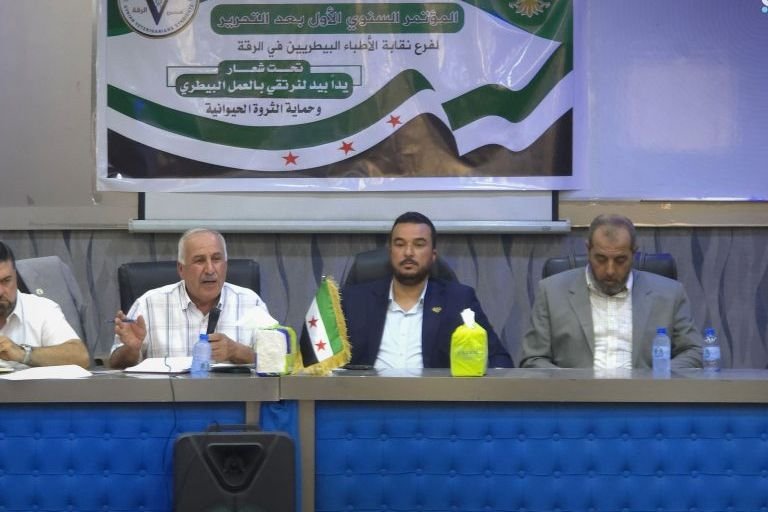
The Veterinarians’ Syndicate in Raqqa held its first annual conference this week, bringing together industry professionals and local officials to address the current state of veterinary medicine in the province and the challenges facing the sector. The event, held under the theme “Hand in Hand to Advance Veterinary Work and Protect Livestock,” focused on the critical role of veterinarians in ensuring animal health, which remains a cornerstone of the region’s agricultural economy and public safety.
Participants at the conference emphasized the need for a comprehensive development strategy for the veterinary profession. Discussions highlighted that the current veterinary landscape requires stronger integration with state institutions, specifically the Ministries of Agriculture and Economy, to improve health services and livestock outcomes. Mohammad Salim Biqai, Secretary of the Veterinarians’ Syndicate in Syria, attended the session and stressed that the primary objective of the conference was to evaluate existing practices, rectify shortcomings, and establish a unified action plan. He noted that the cooperation between the syndicate and relevant government directorates is vital for elevating the standard of veterinary care across the province.
A central topic of the conference was the urgent need to modify internal regulations and administrative systems. These changes are intended to empower veterinarians to perform their duties more effectively, particularly at agricultural sites and border crossings. Biqai pointed out that the control of animal diseases, most notably Foot-and-Mouth Disease, remains a significant hurdle. Such outbreaks not only endanger livestock populations but also cause substantial economic losses for local breeders. To mitigate these risks, the conference called for the implementation of comprehensive vaccination programs developed in partnership with the Ministry of Agriculture. Furthermore, the role of veterinarians at border crossings was identified as an essential line of defense in monitoring and controlling transboundary animal diseases.
The scope of the discussion extended beyond animal health, touching upon the intersection of veterinary science and public health. Experts at the conference highlighted the dangers posed by zoonotic diseases—illnesses that can be transmitted from animals to humans—with a particular emphasis on the risks associated with rabies, which remains a serious threat to the community, especially children. Proactive measures, including robust animal vaccination programs and public awareness initiatives, were cited as necessary steps to safeguard the population.
Abdul Ahmed Al-Taha, head of the Raqqa branch of the Veterinarians’ Syndicate, outlined several practical requirements to support the local veterinary community. With 94 registered veterinarians currently operating in Raqqa, Al-Taha emphasized the importance of securing a dedicated headquarters for the syndicate to streamline organizational work. He also proposed the creation of specialized training courses for new graduates and the establishment of localized research centers to improve diagnostic accuracy and treatment protocols for endemic diseases. Al-Taha underscored the necessity of strict professional oversight, advocating for the restriction of veterinary services to qualified specialists and the enforcement of stronger regulatory measures in collaboration with agricultural authorities.
