
3D Documentation Begins for Restoration of Roman Theater in Afrin
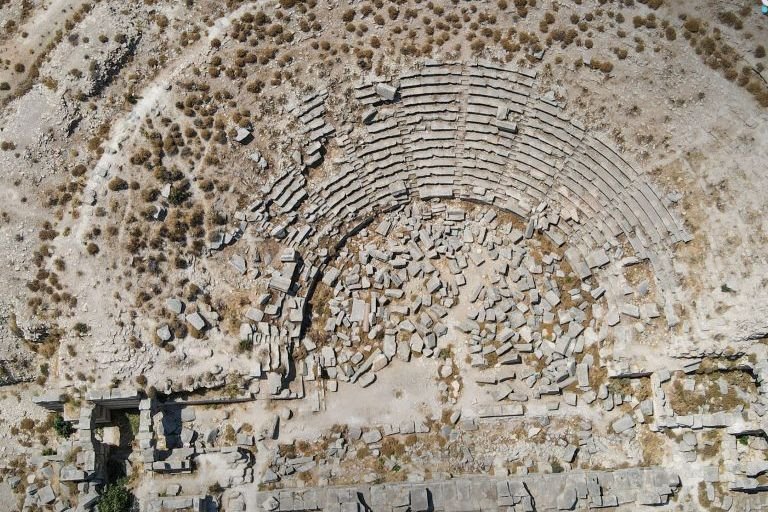
The Directorate of Antiquities and Museums in Aleppo, in collaboration with the Syrian Development Organization and supported by the local governorate, has officially launched a field initiative to document the ancient Roman Theater in the Nabi Huri archaeological site, located in the Afrin region of Aleppo’s countryside. The project marks a significant step in the broader effort to protect and rehabilitate Syria’s historical landmarks.
Officials confirmed that the initial phase of the operation focuses on photogrammetry and the creation of high-fidelity three-dimensional models. By utilizing advanced drone technology and digital mapping, the technical team aims to produce high-resolution records of the theater’s structure. According to experts involved in the project, these digital models will provide precise measurements with a margin of error not exceeding 2.5 centimeters, establishing a critical foundation for future engineering studies and restoration work.
Director of Antiquities and Museums in Aleppo, Mounir Al-Qashqash, stated that this project aligns with the Directorate’s strategic plan to extend restoration efforts from urban sites, such as the Aleppo Citadel and the city’s ancient markets, into the surrounding rural areas. The objective is to stabilize and restore the Nabi Huri theater, transforming it into a vibrant center for cultural activities and tourism in the Afrin region.
Local authorities echoed the importance of this site, which is recognized as one of the three largest Roman theaters in Syria. During a field visit to the area, members of the Aleppo executive office noted that the initiative is part of a wider tour of archaeological locations in the region, including the castle of Deir Semaan and the sites of Ain Dara and Kafr Diriya. These efforts are intended to preserve the area’s rich historical and cultural tapestry, ensuring that such landmarks can eventually host public events and welcome visitors once again.
Representatives from the Syrian Development Organization highlighted the importance of the partnership with the Directorate of Antiquities. The focus is currently on developing a comprehensive executive study that will guide the physical restoration and development of the site.
This initiative underscores an ongoing commitment to the preservation of human heritage within Aleppo’s countryside. By combining modern technological tools—such as unmanned aerial vehicles and digital cartography—with expert archaeological oversight, the project aims to safeguard the integrity of the Roman theater’s elements while highlighting their historical and civilizational value for future generations.
