“Miniatures” at Tartus Theatre: Exploring Identity and Memory
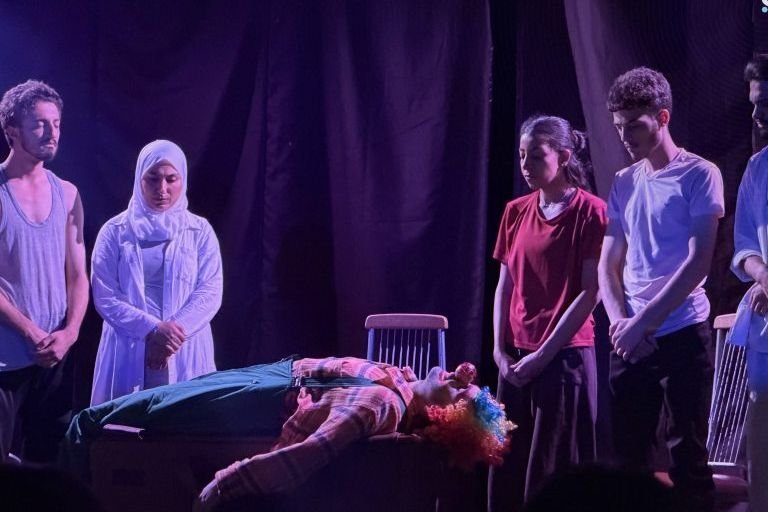
The National Theatre in Tartus hosted the theatrical production “Miniatures” this past Friday, offering an artistic exploration of fundamental questions surrounding identity, belonging, memory, and the experience of travel. The performance was the result of a collaboration between the Scenario Foundation and the Nisan Developmental Foundation, falling under the “And Ibn Battuta Departs” project, which draws inspiration from the life of the renowned Arab explorer.
This production marks the culmination of an intensive four-month training workshop involving 22 young participants. Throughout the program, the participants honed their skills in acting and dramatic writing. Director Sari Mustafa explained that the work seeks to bridge the gap between the past and the present by examining the perspectives of youth regarding the concept of “home” and the individual’s role in society. The play also delves into the dilemma of choosing between remaining in one’s homeland or departing, issues which Mustafa noted reflect a constantly evolving social and human reality.
Mustafa highlighted the production’s inherent flexibility, noting that the dramatic arc underwent continuous development throughout the preparation period. This approach resulted in an interactive experience that remains subject to change based on the nuances of each performance and the audience’s reaction. The director emphasized the importance of such workshops in providing young people with a platform to express themselves and articulate their concerns on stage, while also commending the support provided by the Ministry of Culture for this cultural initiative.
Participating performer Radwan Kreidi, 23, shared his thoughts on the unique nature of the experience. He noted that the texts delivered by the actors, including the monologues, were direct reflections of their authentic personal experiences rather than adapted literary works. Kreidi added that the play seeks to project a positive image of the participants, framing them not as victims of circumstance, but as individuals capable of overcoming adversity and working effectively to achieve desired changes within their environment.
The performance was well-received by the audience, who praised the actors’ ability to evoke human suffering and document individual narratives within a collective memory through both acting and accompanying musical performances. The initiative is rooted in the concept of participatory theatre, which aims to transform the stage into a platform for societal dialogue. In this setting, the performers and the audience engage in an artistic and human exchange that extends beyond the boundaries of traditional theatre, further emphasizing the role of culture in highlighting the current aspirations of Syrian youth.
Source: Syria Focus Arabic
