Dervish Cafe: A Musical Play on Loss and Resilience in Tartus
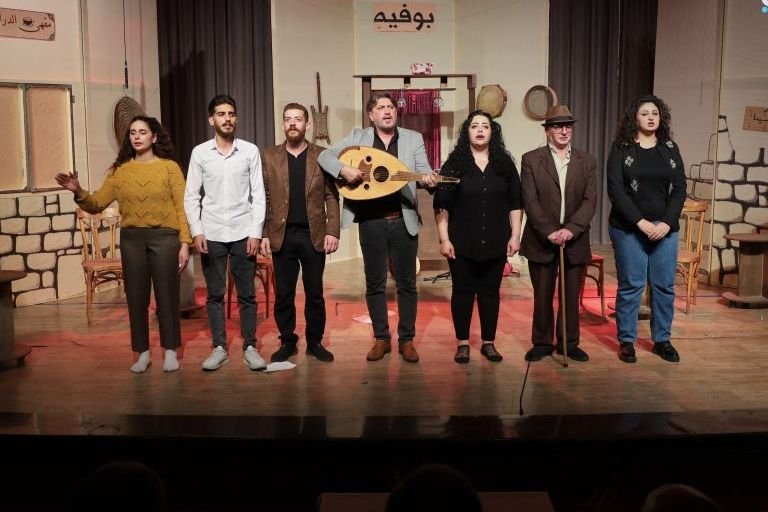
The Arab Cultural Center in Tartus recently hosted the musical play “Dervish Cafe,” a production that sheds light on the human and psychological challenges faced by Syrian youth during the years of war. The work offers a dramatic narrative centered on the experiences of six characters whose paths cross in a cafe between 2011 and 2022, tackling themes of loss, alienation, and the enduring attachment to national roots.
The play is the result of a collaborative effort involving the Directorate of Theaters and Music in Tartus, the Directorate of Culture, and the “Voice of the Theater” troupe, which is affiliated with the Syrian Engineers Syndicate in Tartus. The script was written by Musab Al-Sheikh Ali and Bana Khadour, while Ali Abdul Hamid handled the adaptation and direction.
In a statement, director Ali Abdul Hamid explained that the musical-theater format was chosen to effectively convey the human and emotional depth of the story, blending music with performance. Abdul Hamid, who also appears in the play as a former employee transformed by the war into a “dervish,” noted that his character embodies the profound impact of the conflict on the individual. He further highlighted that the production has previously participated in the Central Syrian Theater Festival and the Hama Sub-festival, achieving critical success, including a Best Actress award for the performer playing the character of Pascal.
Artist Zahra Qassab, who portrayed Pascal, spoke about the deep connection between her character and the homeland. She described Pascal—the owner of the cafe—as a symbol of a spirit deeply rooted in the land, providing a sense of shelter to others despite the prevailing atmosphere of hardship and departure. Qassab noted that this role marks her return to the stage after a twelve-year hiatus.
Representatives Hala Hussein and Ola Attieh, from the Activity and Media Committee of the Engineers Syndicate, emphasized that the project is part of a broader effort to support artistic and cultural talent. They noted that the play highlights Syrian creativity across various fields and was developed in coordination with the Committee of Syrian Female Engineers. The production involved a large team of artists and technicians who worked on the set design, lighting, costumes, and soundtrack, creating a comprehensive experience that reflects the issues of Syrian society and the effects of the war on individual lives.
This theatrical performance is part of ongoing cultural initiatives in the Tartus governorate aimed at revitalizing the local arts scene and providing expressive platforms to address social issues and the human impact of the war, ultimately conveying a message of belonging and attachment to the land.
Source: Syria Focus Arabic
