Damascus Cultural Event Highlights Linguistics and Literary Proofreading
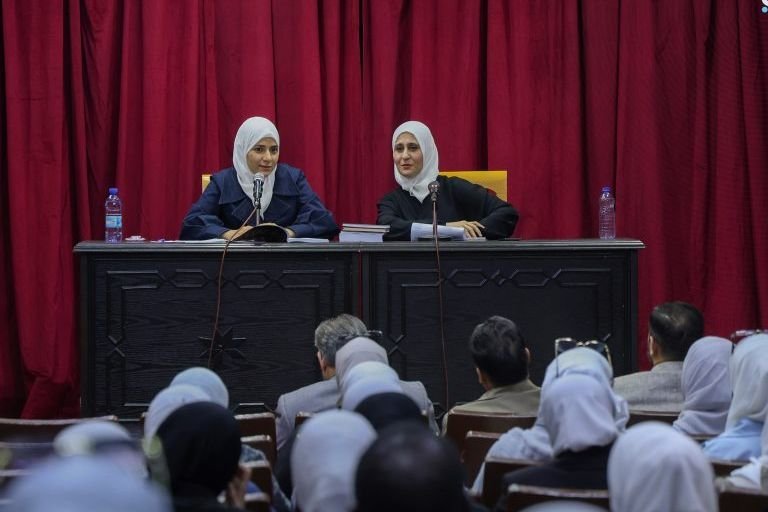
The Arab Cultural Center in the Abu Rummaneh district of Damascus hosted a significant cultural event on Monday as part of the “Book Week” program. The event featured a comprehensive presentation by Syrian researcher and author Asmaa Rizk, who discussed several of her works and concluded the session with a signing of her specialized book on linguistic proofreading.
The event drew a large audience of academics, students, and individuals interested in cultural affairs. Discussions centered on the importance of maintaining the integrity of the Arabic language and the essential role of linguistic proofreading as an intellectual tool for preserving meaning and enhancing text quality. Rizk, who holds master’s and doctoral degrees in linguistics from Damascus University, emphasized during her presentation that proofreading is more than the mere correction of spelling and grammatical errors. She described it as a creative process rooted in a deep understanding of context, noting that even minor changes to diacritics or individual letters can fundamentally alter a text’s intended meaning.
Addressing the professional development of the field, the researcher advocated for the inclusion of proofreading courses within university curricula to better prepare specialized cadres. She also explored the complex intersection between language and artificial intelligence. Rizk cautioned against an over-reliance on automated correction software, arguing that such tools lack the ability to grasp semantic nuances. She provided practical examples demonstrating how automated translation and correction in educational texts have led to unacceptable shifts in meaning.
In a different segment of the event, Rizk discussed her book “Kunuz” (Treasures), which examines the challenges faced by those pursuing knowledge, particularly women. She highlighted historical examples of women who contributed to the development of scientific institutions. Regarding the future of literacy, she suggested that fostering a culture of reading among younger generations requires pedagogical methods based on storytelling and leading by example, rather than direct preaching.
Rizk concluded her remarks by encouraging researchers to approach modern linguistic theories with a critical eye while preserving the cumulative achievements of traditional Arabic grammar and rhetoric. She recommended increasing the translation of heritage works to serve as a bridge between ancient Arabic scholars and contemporary researchers. In her closing comments, she emphasized that dedicating time to daily reading remains a fundamental pillar for preserving the identity of both the individual and society.
Source: Syria Focus Arabic
