
“The Caravan” Exhibition in Homs Recalls Memory and Artistic Journey
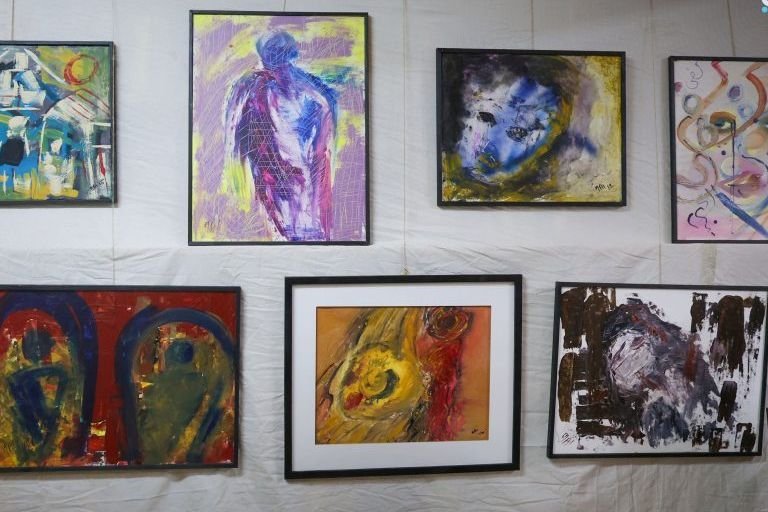
The city of Homs recently hosted the opening of a distinctive art exhibition titled “The Caravan,” featuring the work of visual artist May Majid al-Atassi al-Husseini. The event, held at the Robert Skaff Library, was sponsored by the Presbyterian Evangelical Church in Homs and drew a notable audience of art experts, intellectuals, and those interested in the visual arts in the province.
The exhibition showcases approximately 48 diverse artworks. Throughout these pieces, the artist utilizes various techniques and materials, including acrylics, ink, and watercolors, applied to a range of mediums such as fabric, canvas, and cardboard. These works represent the culmination of a profound artistic journey spanning more than a decade—a period marked by complex human emotions, including alienation and nostalgia, anger and anxiety, and ultimately, the seeds of hope. Themes concerning women and femininity also feature prominently across many of the canvases.
In a statement, the artist explained that the title “The Caravan” was inspired by a newspaper her father published in the 1950s. The name carries symbolic significance, intersecting with her own personal trajectory, which she described as a “long road” characterized by experiences of migration, estrangement, and a persistent dream of returning to Syria. She noted that her creative practice, which began 13 years ago, has become a tool for self-discovery and the expression of her inner thoughts. She emphasized that she does not adhere to any specific school of art, instead allowing her spontaneity and personal mood to dictate the choice of colors and the composition of each painting.
Prominent artists and creatives in attendance praised the quality of the exhibition. Visual artist Rizqallah Hallaq noted that the works demonstrate a clear influence of contemporary trends in modern art. He commended the artist’s freedom of expression and her selection of formal elements, expressing his hope that this experience would serve as an incentive for Syrian artists living abroad to return and hold exhibitions within the country. Additionally, stage director Abdul Karim Omareen described the exhibition as an exceptional experience. He highlighted the technical balance the artist achieved between mass, color, and lighting, stating that the paintings evoke a sense of vitality and optimism in the viewer.
Al-Atassi al-Husseini’s works reflect her desire to build a bridge of connection with her homeland through art. She expressed her hope that her pieces would reach the homes of Syrians, becoming part of their personal memories and the memory of the place itself. The exhibition will remain open to visitors until the ninth of this month, serving as a space for dialogue between the artist and the public and representing a serious attempt to restore a connection to the place through artistic creation.
Source: Syria Focus Arabic
